
Beyond Semantics: The Flaws of Cult Apologists & ‘New Religious Movements’ Scholarship

Response to Bitter Winter’s Critiques of the Victorian Inquiry into High-Control Groups

Some things are better ignored than responded too, at least that is the attitude I’ve had up until now towards Bitter Winter’s articles about the Victorian Parliamentary Inquiry into cults, organised fringe groups, and coercive control. However, the latest article has me saying “enough is enough”— oh my, there is so much that could be said. But rather than jump straight into the emotions (which are definitely there), I want to approach this as a media analyst and someone who has personally engaged with this inquiry.
About the Author and the Platform
The latest Bitter Winter article was written by Geraldine Smith, whom I’ve met a couple of times during her research on my daughter’s cult. She even attended my daughter’s wedding—something I once viewed as a sign of openness, back when I was still naïve about how high-control groups operate. I have no personal issue with Smith, but I am not impressed with her academic work, as I find her research to be woefully incomplete. She relies almost entirely on speaking with group members, and accepting cult leader’s narratives uncritically while failing to verify claims with victims or families. She also lacks training in psychology and trauma—two core disciplines for understanding coercive environments.
Despite having directly observed practices in the “Kidney Cult” (aka Jesus Christians) such as constant surveillance, peer policing, rigid rule-enforcement, and behavioural monitoring, she has not recognised these as forms of coercive control or breaches of basic human rights. This narrow methodology is not unique to Smith—it reflects longstanding problems within the broader field of new religious movement (NRM) studies.
NRM scholarship, established in the mid-20th century, positioned itself as a defender of religious freedom and has struggled to evolve alongside contemporary research on trauma, coercive control, neuroscience, and the nervous system. Too often, theoretical loyalty overrides critical thinking, and academic neutrality becomes a shield that obscures harm rather than illuminates it. As a result, the discipline has gained a reputation for giving disproportionate weight to the narratives of group leaders while minimising or dismissing the experiences of victims. It remains one of the most contested and ethically fraught areas of social-scientific research.
“Bitter Winter does not take positions on political issues and limits itself to the field of human rights.” – Bitter Winter ‘About’ page
A stark example is Bitter Winter, published by CESNUR (Center for Studies on New Religions) and edited by sociologist Massimo Introvigne. Although it claims to advocate for religious liberty, critics note that it consistently offers favourable, uncritical coverage of controversial and high-control groups. My own experience aligns with these concerns: Introvigne has publicly supported false claims made by my daughter’s cult leader and has not been willing to engage in open dialogue to hear my side of the story—his loyalty to cult leaders is renown. In effect, he elevated the supposed “rights” of a manipulative leader over my basic human rights. This is how cult apologetics works—by reframing coercion as “freedom” and dismissing the people harmed by it.
The bottom line is simple: when “freedom of religion” is used to excuse violations of fundamental human rights—freedom from surveillance, the right to family connection, bodily autonomy, and protection from exploitation—we are no longer talking about religious freedom. We are talking about a smokescreen. A mechanism that allows abuse to operate without scrutiny.
Publications like Bitter Winter work to preserve the grey zones and loopholes that enable high-control groups to evade accountability. Victoria’s inquiry, by contrast, exists to close those gaps—not to judge anyone’s theology, but to expose the harm concealed behind misused language, legal technicalities, and selective appeals to human rights.
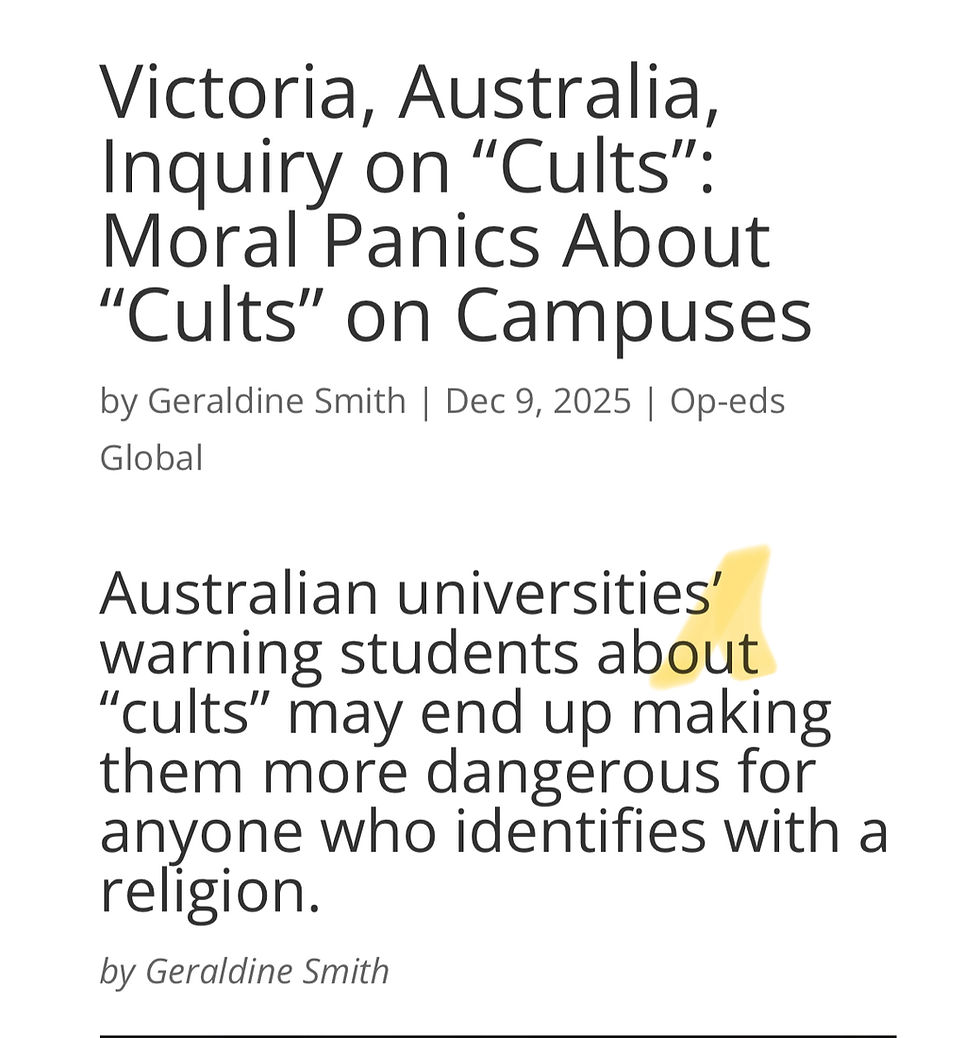
The Article
The title alone—“Victoria, Australia, Inquiry on ‘Cults’: Moral Panics About ‘Cults’ on Campuses”—tells you everything you need to know. It frames the inquiry and the universities who have participated in the process as overreacting or engaging in hysteria. But the more you examine this claim, the more it unravels.
Moral panic is a very specific sociological term. It refers to a situation where a group is exaggeratedly portrayed as a threat despite minimal evidence—usually fuelled by sensationalist media, public hysteria, and political opportunism (think the “Satanic Panic” of the 1980s). None of these conditions are present here. The Victorian Inquiry is grounded in hundreds of detailed submissions, testimony from survivors, families, professionals, clinicians, and frontline workers. The Committee’s mandate was not sparked by tabloid fear-mongering—it came from real harm, reported consistently across diverse groups, including not just new religious movements but also megachurches, political cults, self-development groups, and esoteric spiritual movements. This is not panic. This is evidence-based governance responding to documented coercive control, financial exploitation, family estrangement, and psychological harm. Calling this “moral panic” is not only incorrect—it erases the lived experiences of those who have been seriously harmed.
The tone of the article is set immediately beneath its very first image — a screenshot from an ABC documentary captioned:
“Anti-cult propaganda about university students recruited and ‘brainwashed’ by Shincheonji aired on public service taxpayers-funded Australian network ABC.”
But public broadcasters reporting on documented harm is not “propaganda,” and the ABC’s coverage of Shincheonji does not rely on sensationalist language like “brainwashing.” It reports verified facts, survivor accounts, expert commentary, and community concerns — which is standard journalistic practice, not an “anti-cult agenda.”
Dismissing any critical reporting as “anti-cult” is a rhetorical tactic designed to delegitimise scrutiny rather than respond to the evidence. And the ABC is hardly alone: multiple international media outlets, researchers, regulators, and governments have raised consistent concerns about Shincheonji’s recruitment methods and internal controls. The pattern is clear — this is not bias. It’s reporting.
The Claim That University Warnings Are “Overblown”
Smith suggests that university advisories about predatory religious or ideological groups are unnecessary or exaggerated.
Let’s be clear:
Universities warn students about anything that poses a potential risk—scams, fake job ads, drink-spiking, predatory behaviour, dodgy landlords, unsafe events. High-control groups, which target isolated, first-year, and international students, are no different.
These warnings did not appear out of thin air. They were triggered by actual complaints, real incidents, and clear, consistent patterns of coercive tactics reported by students.
In her article, Smith fixates on the frequency with which Shincheonji is mentioned—implying that universities and the inquiry are overreacting. Yes, Shincheonji does come up often, but there are two very simple reasons for that: 1. Shincheonji leave recognisable posters around universities, and 2. There is a strong, organised body of ex-members who feel safe enough to speak publicly and advocate for change.
Smith frames Shincheonji’s covert evangelism as a defensive response to alleged persecution, but this grossly misrepresents the reality. She writes:
“To be clear, Shincheonji is a religion, its members are religious in the same way that Catholics, Muslims, or Jews are religious. It is not a ‘cult’ or ‘pseudo-religion,’ and its members deserve the same respect afforded to every other religion.”
No—Shincheonji is not comparable to those mainstream faiths (and it can be noted that cult offshoots of all of these religions have come up in the inquiry). While its members hold genuine religious beliefs, the organisation systematically engages in manipulative and harmful practices that go far beyond ordinary religious observance.
Members are instructed to collect personal information via personality tests to target potential recruits. They are encouraged to lie about the group’s identity, conceal affiliations, and fabricate personal relationships to gain trust. Students and recruits are pressured to abandon studies, careers, and social commitments, often resulting in isolation from family and friends. Reports also describe intensive indoctrination sessions, strict regulation of personal time, and the use of guilt and shame to enforce compliance.
These behaviours constitute coercive control, not defensive self-protection. Smith’s framing ignores these documented harms and the lived experiences of those affected. Her argument is as illogical as claiming financial scammers are justified in lying because people would not hand over money otherwise. Coercion and deception cannot be excused by perceived external threats.
If Smith had been following the inquiry accurately then she would be aware that the committee has already been briefed on Shinjeonji’s harmful behaviours from ex-members. Therefore it was on the backdrop of those already established points that the university representatives were asked to present their insights. To miss this point is to put the cart before the horse.
And it is not just Shinjeonji. Many other high-control groups target university students on campus—including the Kidney Cult (which Smith should be aware of given her prior research). However, these lack the same number of ex-members or the safety and capacity to speak out. The World Mission Society Church of God is another group known to specifically target university students, but in reality, there are countless others. Their members are isolated. Their numbers are smaller. Their ex-members are traumatised. The absence of public testimony does not mean the absence of harm.
And it needs to be stressed that a lot of inquiry testimonies have been done in private: 317 anonymous surveys, 20% (56) of the 280 written submissions are private, and there have been an undisclosed number of private hearings too.
A genuine expert in “new religious movements” should understand these nuances. But instead, Smith frames universities as being insufficiently accommodating of these groups, even saying:
“If universities are committed to promoting respect towards religious and spiritual diversity, they should do so without exception. RMIT is committed to an Inclusion, Diversity, Equity and Access Framework which affirms its commitment to ‘ensure inclusive and equitable experiences and outcomes’ for ‘cultural, linguistic and religious diversity.’”
This argument collapses under scrutiny. Any group—religious or otherwise—that uses coercion, deception, intimidation, spiritual manipulation, or us-versus-them rhetoric is violating the very principles of inclusion and equity that universities are obligated to uphold.
Inclusion does not mean giving harmful groups a free pass.
Diversity does not mean tolerating deception or bullying.
Equity does not mean leaving students vulnerable to exploitation.
Back to the article:
Smith selectively quotes RMIT representative Dene Cicci to imply that only a small handful of officials reported concerns between 2023–25, and therefore the issue is negligible. She further casts doubt on ACU Professor Julie Cogin’s comments by framing anecdotal evidence as inherently unreliable.
This is a biased and superficial reading. It erases the hundreds of submissions referencing multiple high-control groups across the state. It ignores established patterns of behaviour. And it disregards the broader scope of the inquiry, which is—notably—not limited to universities at all. As Cici said, the recruitment process doesn’t always happen on campus but even when it happens adjacently, its impact on students is still of concern. Moreover, there is presently no clear pathway for reporting high-control groups to anyone.
To dismiss these warnings as “fear-mongering” is to dismiss the students who have been manipulated, pressured, isolated, and exploited. It invalidates lived experience. And worst of all, it frames safeguarding as persecution.
This isn’t hysteria.
This is simply duty of care.
Cult Apologists' Fixation on Terminology Instead of Harm
A large portion of Smith’s argument revolves around the word “cult,” as if the entire inquiry hinges on a disputed label. It doesn’t.
The inquiry uses other terminology that Smith has not addressed, namely:
Organised fringe groups
Coercive control
These terms are directly aligned with the inquiry’s mandate, focusing on observable behaviour rather than belief.
Moreover, as the inquiry has progressed, the term “high-control group” has been increasingly adopted by committee members and the media as a replacement for “cult.” This change, introduced via the Beyond Belief group submission, has been referenced in multiple hearings and even discussed at length by its lead author, Patrick McIvor, as a blueprint for future directions. One would hope this would address the concerns of those critical of the “cult” label—but it appears cult apologists have largely ignored or dismissed this shift.
Having said that, victims didn’t submit testimonies because the word “cult” was misattributed to a group we’re affiliated with.
They’ve submitted testimonies because they were:
manipulated
isolated
controlled
exploited
traumatised
As always, when arguments are centred on semantics, discussions of the actual evidence of harm gets sidelined. It’s a strategy often used by groups under scrutiny: argue about definitions to avoid accountability for behaviour.
Smith Misrepresents the Scope of the Inquiry

Smith portrays the inquiry as targeting minority faiths or “new religions.” This is categorically false.
The inquiry is examining:
new religious movements
and megachurches
and older established churches
and health and wellness groups
and political/ideological movements
and online cult-like networks
and self-development organisations
and spiritual/meditation groups
and any other organised fringe group
The scope is broad because coercive control can occur anywhere. No denomination or ideology has a monopoly on manipulation.
To claim otherwise is to either misunderstand the inquiry—or intentionally distort its purpose.
And Smith consistently leaves out the voices of victims and families, the very people whose experiences form the backbone of the inquiry.
Not All ‘Religions’ Are Equal
Smith writes:
“The problem with these (inquiry) guidelines is that it could describe how any religious, spiritual, or secular organization, which is soliciting donations, advertising events, or raising awareness on an issue, may approach someone.”
No. This is taking the issue completely out of context.
Survivors repeatedly describe how these groups initially present as welcoming, supportive, or even beneficial. They speak about positive experiences that drew them in—friendly peers, shared interests, or community support. What distinguishes high-control groups is what happens next: the coercion escalates. Gradually, members experience manipulation, pressure to conform, isolation from family, and exploitation.
This is not the same as a mainstream religious group asking for donations or inviting someone to a discussion. It is more like an abusive relationship: initial interactions may seem benign—or even positive—but over time, controlling behaviour escalates and causes real harm. Imagine arguing that we should do nothing to prevent coercive control in domestic violence simply because some manipulative behaviours initially resemble healthy relationships. That’s the logic these guidelines are challenging. They map the full cycle of coercion, which mirrors abusive intimate relationships that often begin with love bombing and a “happy days”, honeymoon period. Just as Australia has developed guidelines to distinguish harmful vs. healthy relationships, there is no reason the same cannot be done for group-based coercive control.
The fact that both healthy and harmful communities can both look the same at the point of entry, is a chilling reminder of how manipulative techniques can be so misleading. The facade of a safe group is often a deliberate ploy used to build trust prior to exploitation.
Smith:
“Australian universities’ warning students about “cults” may end up making them more dangerous for anyone who identifies with a religion.”
No. Just no, that’s not how it works. By addressing these patterns and educating students, universities aren’t threatening religions—they are helping prevent coercive, manipulative behaviour. In fact, the more high-control tactics are stamped out, the safer it becomes for all religious and spiritual communities to operate freely without being conflated with abusive practices.
There have been a number of religious, spiritual, and secular organisations who have come forward to support the inquiry because they do not want to be misjudged as being harmful.
Now the Bigger Question: Why Is Bitter Winter So Invested?
This is the fourth article Bitter Winter has published about this inquiry in as many weeks.
Four articles.
On one state-level inquiry.
In Australia.
From a European platform.
It is… unusual.
So we have to ask: Why?
Why such sustained effort to undermine an inquiry whose goal is harm reduction?
Why so much urgency to frame victims as hysterical and institutions as irrational?
Why such feverish attempts to paint any examination of coercive control as “persecution”?
At a certain point, the motive becomes hard to ignore.
Is Bitter Winter trying to:
delegitimise the Victorian inquiry?
discourage other states from initiating similar investigations?
shape international perception before global momentum builds?
protect the groups and leaders whose behaviour thrives in silence and opacity?
Because here is the uncomfortable truth:
Inquiries lead to findings.
Findings lead to recommendations.
Recommendations lead to regulation.
Regulation leads to accountability.
And high-control groups—and those who defend them—have always resisted accountability.
The public deserves to understand why a platform known for defending controversial groups is investing so much energy into reframing an inquiry designed to protect vulnerable people.
And while rumours circulate that Bitter Winter receives financial support from high-control groups seeking legitimacy, one thing should be absolutely clear:
No survivor who submitted testimony to this inquiry is being paid.
No grieving parent, no targeted student, no former member risking retaliation for speaking out is receiving funding.
We do this because we want the harm to stop.
Survivors deserve better than to have their experiences dismissed as nothing more than “moral panic.”
A Final Note on Smith’s “More Constructive Response” Argument
Smith writes:
“Some religious and spiritual organizations can and have caused catastrophic harm, yet a more constructive response would be to educate students on how to identify harmful behaviors… without targeting specific groups lumbered with the nebulous category of ‘cult.’”
On the surface, it sounds reasonable.
But in practice, it’s a throwaway commentary, because Smith:
provides no insight or examples of catastrophic harm
does not acknowledge the extensive testimony about Shincheonji, including patterns documented across multiple countries
ignores the fact that victims of smaller high-control groups can’t defend themselves publicly because members fear retaliation
fails to recognise that the inquiry already focuses on behaviours, not theology
and completely overlooks the hundreds of submissions detailing coercion, deception, intimidation, isolation, financial exploitation, and psychological manipulation
A critique that refuses to engage with the evidence is not a critique.
It is a deflection.
And to argue that universities should “accommodate” any and all religious groups—without exception—ignores a fundamental principle:
Any group, regardless of belief system, that uses coercion, deception, intimidation, or us-versus-them rhetoric is not entitled to institutional protection.
Universities have a duty of care.
They must safeguard students—including by taking action when groups discriminate, recruit deceptively, or interfere with academic, social, and family wellbeing.
To pretend this is about suppressing religion rather than addressing documented harm is intellectually dishonest, ethically reckless, and deeply disrespectful to those who have suffered.
Comments