
The Curse of Ancient Ignorance: Calling Human Traits “Masculine” and “Feminine”

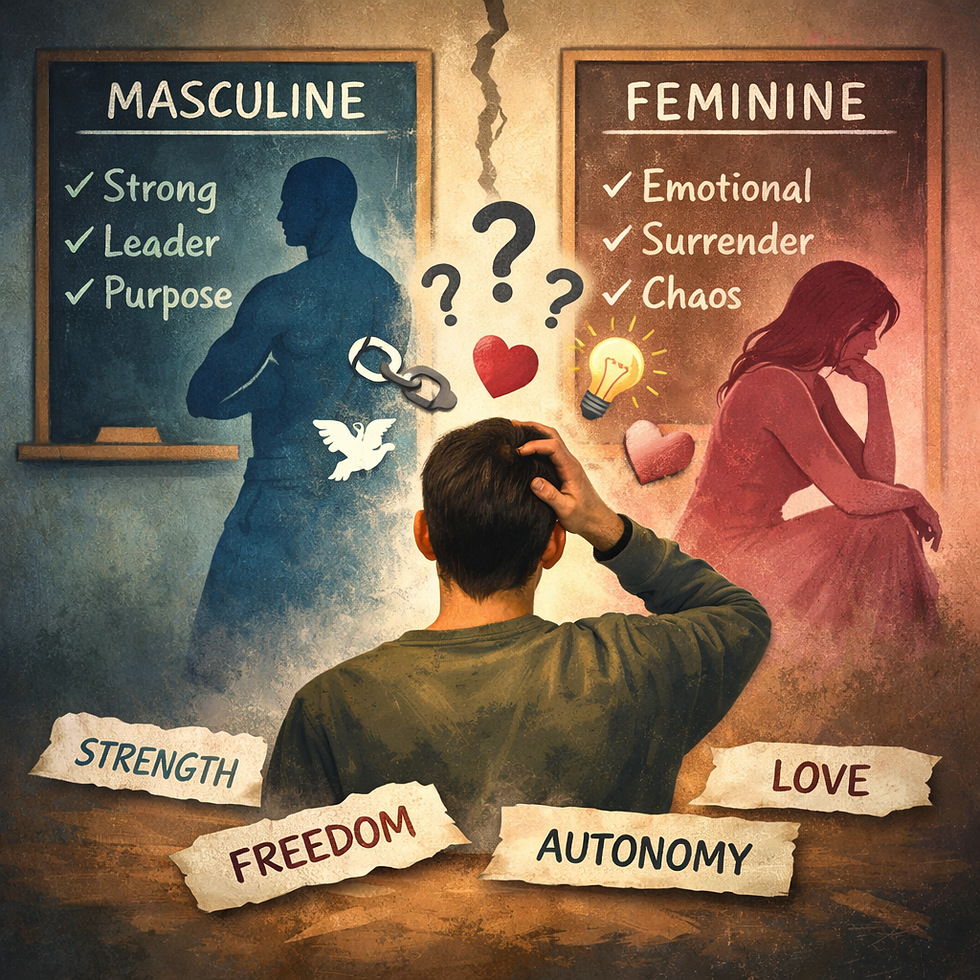
I wish we could normalise something very simple: Acknowledging what it actually means to be human.
Because somewhere along the way, we’ve taken core human experiences—things like strength, freedom, capability, emotional depth, purpose—and divided them into “masculine” and “feminine” traits. And once you really look at that move, it doesn’t make sense. It creates confusion at best, and at worst, it becomes a tool for control.
Let’s start with the basics.
Humans, regardless of gender, want to feel strong. We want to feel free. We want to feel capable.
That’s not ideology. That’s baseline psychology.
Decades of research in Self-Determination Theory show that autonomy, competence, and agency are essential for good mental health. Not masculine. Not feminine. Human.
So when a framework comes along and starts assigning those qualities to one gender—usually men—and then defining the other gender in opposition, it should raise questions.
When “Spiritual Teachings” Start Rewriting Reality
A really clear example of this shows up in the work of David Deida, particularly in The Way of the Superior Man:
Traditionally, young women were understood to offer a man a particularly rejuvenative quality of energy. Older women may maintain, or even increase the freshness and radiance of their energy, but it is rare.
His framework is often presented as deep, spiritual, even liberating. But if you strip away the language, the core claims look like this:
Men = direction, purpose, strength
Women = emotion, chaos, surrender
He repeatedly suggests that women want to surrender, to be “taken,” to feel a man’s strength as something they yield to.
Now pause there.
Because what’s happening isn’t just a description of difference—it’s a redefinition of human needs.
The desire for safety becomes “wanting to be taken.” The desire for connection becomes “wanting to surrender.” The desire for emotional attunement becomes “testing masculine strength.”
It sounds poetic. But psychologically, it’s a reframing exercise.
The Quiet Inversion
Here’s where it becomes a problem.
If you tell women that their natural desire for autonomy, capability, and independence is unfeminine, you create internal conflict.
If you tell them that what they really want is surrender, weakness, or dependence—even when their own experience says otherwise—you teach them to distrust themselves.
And once someone starts distrusting their own instincts, they become much easier to influence.
That’s not empowerment. That’s a loss of agency dressed up as wisdom.
Let’s Talk About Logic for a Second
There’s also a contradiction that doesn’t get called out enough.
These same frameworks often position men as the rational, grounded leaders.
But the claims themselves?
They’re not evidence-based. They’re not grounded in psychological science. They’re broad, emotionally driven generalisations about half the population.
There is nothing rational about ignoring well-established research that shows autonomy and agency are fundamental human needs.
There is nothing logical about assigning “purpose” to men and “love” to women, as though either gender is missing half the human experience.
It’s not science. It’s storytelling.
And not very good storytelling at that.
Why This Matters More Than It Seems
You might hear all this and think, “Okay, but it’s just a belief system. People can take it or leave it.”
But that’s the thing.
Frameworks like this don’t just describe reality—they shape it.
When repeated enough, they:
normalise inequality
justify power imbalances
and subtly train people to accept less autonomy than they would otherwise demand
And that’s where the overlap with high-control dynamics starts to show.
Because one of the most reliable ways to control people is to redefine their internal experience in a way that benefits the system.
A Simple Reset On Human Traits
So here’s a much simpler, evidence-based, reality-aligned position:
No human being wants to feel weak, captured, or inadequate.
People want:
autonomy
capability
connection
meaning
All of us.
Not masculine. Not feminine. Human.
A Final Thought
These days, whenever I hear rigid claims about what men and women “are” at their core—especially when those claims require one group to shrink, surrender, or second-guess themselves—I don’t hear truth.
I hear a framework trying to pass itself off as wisdom.
And more often than not, I start to wonder:
Who benefits from people believing this?
Moreover, it is clear we are not referring to ancient wisdom, but ancient ignorance.
Comments