
Raped While Asleep: What the “Rape Academy” Story Is Missing


CONTENT WARNING: This post discusses sexual assault. Read with care and seek support if needed.
I’m making a vulnerable post I never thought I’d write.
This is a part of my story I’ve kept to myself for many years.
I’ve carried it quietly. Like something that needed to be contained.
But watching everything come out right now about the “rape academy”… something in me shifted.
I found myself asking: why am I still quiet? Why am I still carrying shame that was never mine to begin with?
So I’m saying something now.
Because while these stories are everywhere, there’s still something missing: the voices of people who’ve actually lived it.
In April 2026, an investigation by CNN exposed what’s being described as a global online “rape academy”— digital communities (which operate with cult-like features) where men share tactics, encouragement, and footage related to the drugging and assault of women, often their own partners. The scale is confronting, with some platforms drawing millions of views and entire forums dedicated to targeting women who are unconscious or incapacitated.
Watching these stories come out has hit very close to home.
This is a “me too” moment I wish I wasn’t part of. You rarely hear from us because the backlash can be re-traumatising. We’re told it couldn’t have been that bad because it was our partner. We’re told to forgive and forget. To think about our kids—that it will harm them if their father is charged with sexual assault. And if you come from a new-age or spiritual-adjacent background, you might also hear things like: you chose this before reincarnating, or it’s karma from a past life.
Honestly—what the actual fuck.
When I challenged someone who said that to me, they tried to tell me I wasn’t spiritually evolved enough to understand. These days, I’m far less polite. If someone tries to dress up abuse as spiritual wisdom, I’ll tell them exactly where they can go.
Now to bust a few myths.
When a woman is assaulted while unconscious, one of two things often happens. Sometimes she doesn’t consciously know what’s happened—but she feels different. Off. I remember feeling strange for days, not understanding why, until my abuser casually told me we’d had sex. I felt sick. I knew I hadn’t consented, but because alcohol was involved, I blamed myself.
The other possibility is waking up during the act. It’s hard to describe, but the closest I can get is this: it feels like boiling water or sandpaper against your most sensitive parts. And even then, I was made to feel like something was wrong with my body—that the pain meant there was something wrong with me—not that something was wrong with what was being done to me. The victim-blaming was another layer of abuse.
In the end, I went to the police, but before I get into that, I want to be really clear about something.
I honestly don’t know the extent to which my ex may or may not have drugged me. He did take advantage of me when I’d been drinking, and he had access to drugs—so it’s possible. But I can’t say that definitively.
What I do know is this: I was assaulted while I was asleep.
Whether that was because I was a deep sleeper, alcohol, or something else… doesn’t actually change the impact. I woke up to being violated. That’s the reality.
And that’s why these “rape academy” stories hit so close to home.
Trying to get justice through the police system was another layer of trauma. I won’t go into all of it here, except to say that at one point I was told charges wouldn’t be laid—not because there wasn’t enough evidence, but because there were too many incidents. The concern was how that would translate in terms of punishment for him. Let that sink in. The system couldn’t comprehend the cumulative impact on me.
Before I explain that impact, I want to answer the question people often ask—sometimes directly, sometimes implied: why didn’t you leave sooner?
The worst of this happened about twenty years ago. Before social media. Before widespread understanding of trauma being stored in the body. Before “coercive control” was a recognised term.
He didn’t hit me, so I didn’t recognise it as domestic violence. He punched holes in walls next to my head, and I genuinely believed he’d never hit me directly. Back then, male anger was normalised in ways we’re only now beginning to question.
My confidence was worn down over time. I was told I was dumb. Incompetent. That life would be worse if I left. When I tried to hold him accountable, he told me I was crazy. He threatened to take the kids if I left. I didn’t have language like “gaslighting”—I just knew that when I woke up to being violated, it felt safer to endure the pain than risk his anger spilling over onto the children.
For the most part, I survived by dissociating.
Eventually, I did leave. I had tried before, many times, but this time something shifted. I told him it was over. Still, one morning, he assumed he could take what he wanted while I was asleep.
But I wasn’t asleep.
I jumped out of bed and said, “That’s the last time.” I moved to the sofa and stayed there until I could get out.
Why not sooner? Because previously, even that wasn’t allowed. “Don’t sleep on the sofa, it’ll hurt your back.” It sounds small, even caring. But that’s how coercive control works—small constraints that look like concern, but function to maintain access and power.
About six months after I left, the PTSD became impossible to ignore. I’d wake in the middle of the night, panicked and sobbing. No one was there—but my body remembered. I’d hear myself saying, “Don’t touch me. Leave me alone. I said no.” It felt like my body was rehearsing for a threat that wasn’t present anymore.
Letting a man touch me again after that was one of the most terrifying things I’ve ever done. Not all of those experiences have been positive. But I’ve learned to leave quickly when something doesn’t feel right. And I can say, with complete honesty, I don’t believe I’ve missed out on anything by holding higher standards. I would rather be single than ever experience that kind of violation again.
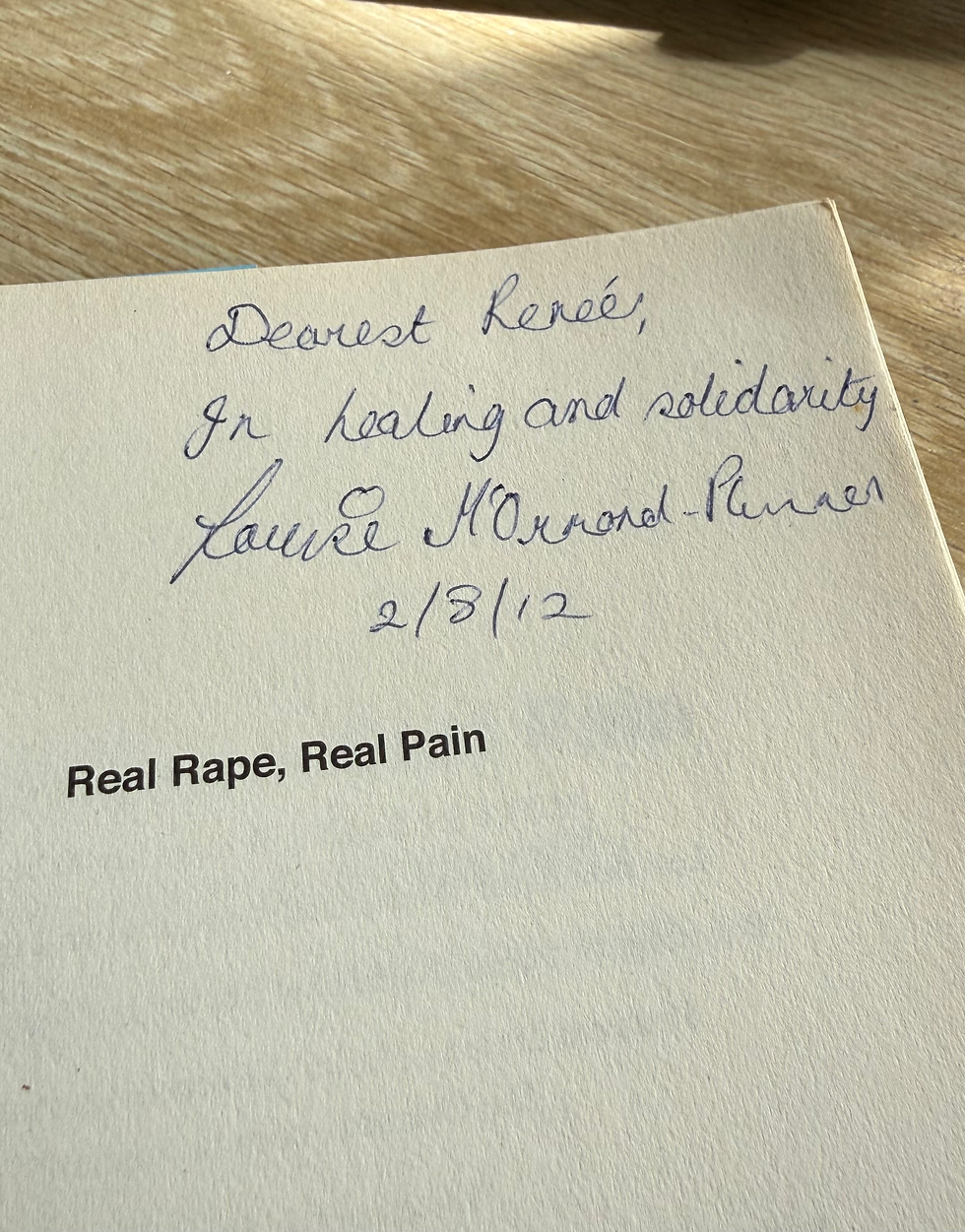
In trying to make sense of what I went through, I read widely. One book I read at the time—Real Rape, Real Pain—pointed out that most women don’t report marital rape for a number of reasons: fear of not being believed, the relatively recent criminalisation of it, and lack of support. That all resonated. But one point stood out most—many women don’t report it because it exists alongside other forms of abuse that feel more immediate or pressing.
What’s also striking to me in the current “rape academy” coverage is the emphasis on drugging.
And to be clear—drugging matters. It shows premeditation. Planning. Intent. That should never be minimised.
But I do think that focus can sometimes pull attention away from something people find harder to sit with: the act of rape itself, and the dynamics of power underneath it.
Because my experience didn’t hinge on that.
I don’t know if I was ever drugged. It’s possible. But what I do know is this: I was raped in my sleep.
And in my case, it escalated most when I tried to leave the relationship.
It wasn’t random. It wasn’t confusion. It was a power move.
A way of teaching me—very clearly—that my words didn’t matter. My “no” didn’t matter. My desire to leave didn’t matter.
It was physical domination. And that didn’t just stay in the body—it shaped my mind, my emotions, my sense of agency. Because all of those systems are connected.
And when I woke up during it, the experience wasn’t ambiguous.
I’ve said this before, but it bears repeating—the closest way I can describe the physical sensation is like sandpaper being scrapped on your genitals.
That is not sex. That is deliberately inflicting pain. That is violation.
So yes, drugging shows planning. But the absence of it doesn’t make what happened any less intentional, or any less about control.
When we look at something like the “rape academy,” we need to understand: this isn’t just about sexual assault in isolation. It sits within a broader pattern of coercion, control, and dehumanisation.
A friend said to me recently that this kind of behaviour reflects something primitive—almost animalistic. I understand the sentiment.
There’s nothing powerful or evolved about overriding another human being’s autonomy. If anything, it reflects a profound lack of emotional and relational capacity. Real strength—real maturity—shows up in the ability to create safety, mutual desire, and genuine connection. The deepest forms of pleasure don’t come from power over someone, but from knowing you can contribute to their sense of joy and agency.
And that’s the standard I choose to live by now.
Comments